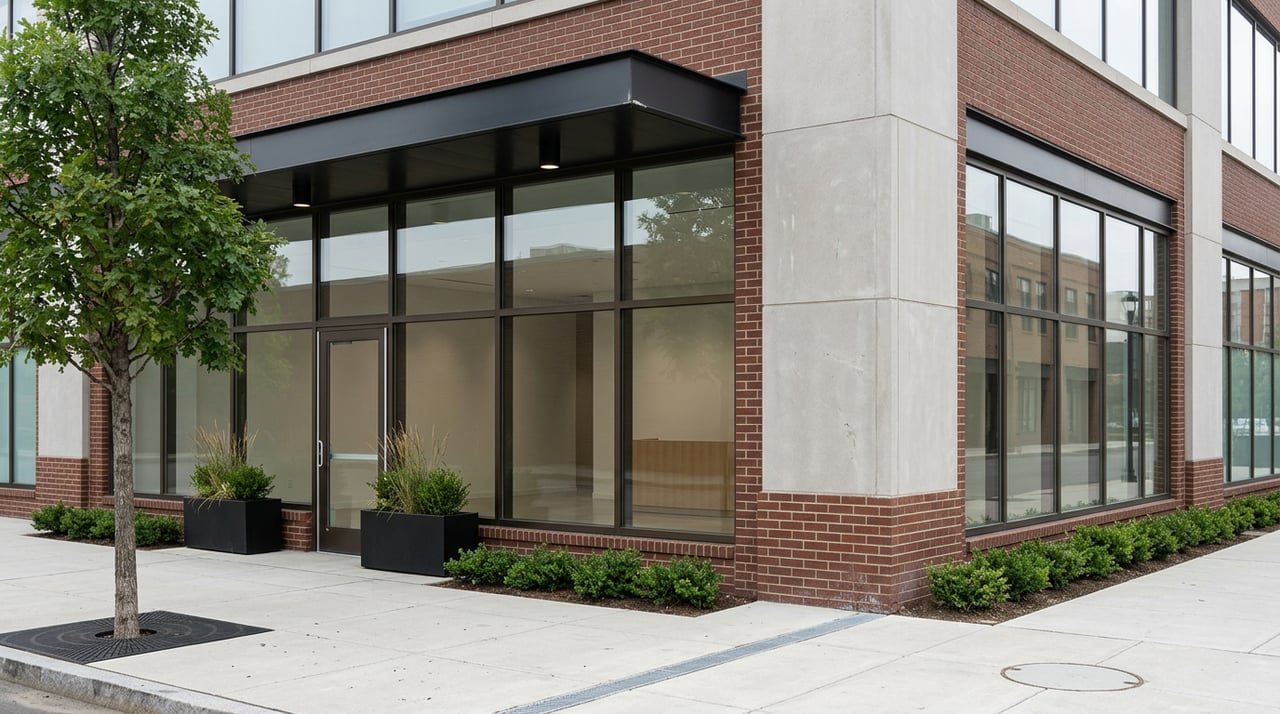
Franklin's office market looks, on paper, like a place you would avoid. Overall vacancy sits near 23%, the highest of any submarket in the Nashville MSA. Yet Class A asking rents keep climbing, developers keep pouring concrete along I-65, and the newest building in Cool Springs just won the region's top office award. Both facts are true at the same time, and the reason they are true is the entire story.
The reader who stops at the headline vacancy walks away with the wrong conclusion. The reader who looks at where tenants are actually moving finds a market that is doing something more interesting than softening. It is sorting itself.
The Number That Misleads
Yardi's 2026 data puts Franklin's office inventory at roughly 10.2 million square feet across properties larger than 50,000 square feet, with about 77% of listed space rated Class A, 22% Class B, and roughly 1% Class C. Average asking rent across the market is $34 per square foot, and Class A specifically averages $35.68. Sale pricing tells a similar story. In 2024, three office transactions closed at a combined $111M with an average sale price of $278 per square foot, compared to a Tennessee statewide average of $129.
Now hold that next to the vacancy figure. If nearly a quarter of the market is empty, why is Class A pricing at more than double the state's per-foot norm and why does new supply keep getting entitled?
Because "vacancy" in Franklin is not a demand problem. It is a distribution problem.
Where the Tenants Actually Went
The most useful lens on Cool Springs right now is not the aggregate. It is the intradistrict migration inside McEwen Northside, the 45-acre Boyle Investment Company and Northwood Ravin joint venture at Aspen Grove Drive.
Consider what has happened inside a single development in the last four years:
- Kimley-Horn arrived in 2022 at 5,721 SF, expanded to 10,964 SF, and then to 15,347 SF in its most recent move, nearly tripling its footprint without leaving the campus.
- Gordon Rees Scully Mansukhani and Gutterglove Pro, both anchored in Block B at 4031 Aspen Grove since 2021 and 2022, expanded into the newer Block E.
- OMNIA Partners took 125,008 SF across all five floors of Block A after relocating from another Franklin address.
- Class A office at the district now totals 600,000 square feet and includes Mitsubishi Motors North American HQ, Omnia Partners, DCS, and TMP.
Block E itself is the punchline. It opened in 2025 at 300,000 square feet across nine stories at 4020 Aspen Grove Drive, took the 2026 NAIOP Middle Tennessee Office Development of the Year award, and was underwritten around a bet that tenants already inside the district would pay more to move up rather than move out.
That bet is winning. And it is not confined to one campus. CBRE is marketing Aureum Cool Springs as up to two 350,000-SF new-construction office buildings near the I-65 and McEwen interchange. Boyle's Franklin Park pipeline contemplates 1.25 million square feet of Class A off I-65. And in May 2026, e|spaces opened its third Franklin flex-office location, a 22,939-square-foot workspace in a modern six-story building at 840 Crescent Centre Drive, targeting exactly the professional service firms that have historically anchored older Class B stock along Mallory Lane and Cool Springs Boulevard.
What the Absorption Tells You About Class B
Here is the mechanism most portal-level takes miss. When a 15,000-SF engineering firm consolidates from an older Cool Springs building into new construction, two things happen. New Class A absorbs a lease. Older Class B loses one. The market-wide vacancy number barely twitches. The lived experience of the two landlords involved is completely different.
For a tenant in older Class B stock who is 12 to 24 months from lease expiration, the practical implication is straightforward. Your building is now competing against a Block E spec suite with structured parking, showers, bike storage, and a Shake Shack downstairs. Your landlord knows it. Renewal economics can move meaningfully on TI dollars, free rent, and expansion options, provided you understand the comp set the landlord is actually worried about, which is usually not the building next door.
The leverage in Franklin office right now does not sit in the shiny new buildings. It sits in the renewal conversation inside the older buildings the shiny ones are pulling from.
For an owner of that older Class B building, the read is different but adjacent. The exit is not another stabilized office trade at $278 per foot. The exit is either a repositioning play, medical office conversion, boutique flex, professional condo, or a discounted sale to a buyer who can carry vacancy while the district sorts itself. Boyle's own portfolio moves show what institutional capital thinks the ground floor looks like: they paid $48.75 million to acquire The McEwen Building from KBS, and Mallory Green traded for $49.5 million on December 5, 2024. Neither price implies distress. Both imply that well-located Cool Springs product still clears, but only when the story matches where the market is going, not where it has been.
Reading the Same Market From Two Sides
The same data set produces two different playbooks depending on which side of the table you sit on.
| Situation | What the 23% vacancy actually means | Where to press |
|---|---|---|
| Tenant, 12 to 24 months from expiration in Class B Cool Springs | Landlord is competing with Block E, Aureum, and Franklin Park for your renewal | TI package, free rent, expansion rights, blend-and-extend timing |
| Owner-occupier evaluating a purchase | Sale comps are thin (3 trades in 2024) and skewed toward premium product | Off-market Class B or medical office condo with owner-user financing |
| Investor underwriting older mid-block stock | Rent roll risk is real; the district is sorting by amenity, not by geography | Repositioning basis, adaptive reuse, or covered-land plays |
| Growing regional company evaluating first Franklin lease | Spec suites at Block E range from ~1,400 to ~31,700 SF and are move-in ready | Speed to occupancy vs. bespoke buildout economics |
The spec-suite range cited above comes directly from Block E's marketing: office suites from 1,410 to 31,681 square feet, including premier spec suites accommodating diverse tenant needs. For a firm that has been trying to size its Cool Springs footprint against a 5,000-SF minimum in an older building, that flexibility is itself a form of pricing pressure on the incumbents.
The Transaction Friction Most Underwriting Misses
Two frictions surface repeatedly on Franklin office deals right now, and neither shows up in a Yardi export.
The first is parking ratio. Older Cool Springs buildings were built to a suburban standard that assumed near-full in-office attendance. Newer product at McEwen Northside is built inside a walkable district with fully integrated commercial, retail, residential, and green space, and its structured parking is priced accordingly. When a tenant migrates from 4.5-per-thousand surface parking to structured parking in a mixed-use podium, the effective occupancy cost changes even when the headline rent looks comparable. Underwriting that ignores this misprices both sides of the trade.
The second is TI amortization on shorter terms. Landlords in older stock are more willing than they were 24 months ago to sign five-year deals in a market that historically preferred seven-to-ten. That shift is where the concessions live. It also means an investor buying into a stabilized rent roll needs to look hard at weighted average lease term, not just occupancy, before writing a 6-cap for what is really a 7.5-cap risk profile.
Franklin is not a market where the median explains the deal. It is a market where the deal explains why the median is misleading.
FAQ
Is Franklin office overbuilt? Overbuilt implies demand has stopped. Demand in Franklin has not stopped, it has concentrated. New Class A keeps absorbing because tenants inside the district are trading up. Older Class B is where the softness sits, and that is a different underwriting problem than a broken market.
Are Class A asking rents actually being paid? Effective rents lag asking rents in any market with rising concessions. Franklin is no exception. The $35.68 Class A ask reported in Yardi's 2026 data is a starting point, not a clearing price. On new construction with structured parking, the all-in economics warrant a line-by-line read.
Is there still a case for buying older Cool Springs office? Yes, but not as a stabilized-rent-roll trade. The case is a repositioning basis or an owner-user acquisition where financing and control matter more than mark-to-market rent. The exit assumption has to match the story.
Where does medical office fit? Franklin's employment base is heavily anchored in healthcare, with Community Health Systems, Fresenius Medical Care, HCA Healthcare, Williamson Medical Center, and Optum among the largest employers. Older Class B buildings with good parking, ground-floor access, and reasonable floorplates convert to medical office more cleanly than they compete on general office. That is a real strategy in this market, not a rhetorical one.
If you own, occupy, or are underwriting Franklin office right now, the headline vacancy number is not the conversation. The conversation is which side of the sort you are standing on and how much time you have before your lease, your comp set, or your basis makes that decision for you. New South Commercial works this market building by building. Request a market consultation and we will pull the specific comps, concession patterns, and off-market opportunities that apply to your address, not the submarket average.